-
 Nami Team
-
 30 July 2026
-
 Technology news
Best Website and Mobile App Design & Development Company | Integrated Digital Solutions
Website and mobile app design and development have become essential digital investments for companies looking to grow their businesses, deliver services to customers, and expand their market reach. A website helps introduce a company and its services and receive customer inquiries, while a mobile app can provide interactive services that simplify purchasing, booking, and follow-up, depending on the project.
The success of a digital project does not depend on attractive design or programming alone. It also requires understanding business needs, defining the required features, choosing suitable technologies, creating a clear user experience, and considering performance, security, and future scalability.
Nami Tec provides digital solutions that help companies turn ideas into technology projects, from planning and design through development and launch. With more than 9 years of experience, Nami Tec provides digital services tailored to the needs of different projects and businesses.
Best Website and Mobile App Design & Development Company
Choosing a website and mobile app design and development company requires evaluating its ability to deliver the project from both technical and practical perspectives, rather than judging only the final design. The right company understands the business, clearly defines requirements, and proposes solutions that match the project’s goals and budget. Explore Nami Tec’s range of services to learn about available solutions for websites, mobile apps, and different technical needs.
Key criteria to consider when choosing a company include:
-
Experience and portfolio: Review previous projects to understand the company’s experience in developing websites, online stores, and mobile applications.
-
Understanding project needs: Define the core features and the problems the website or app is intended to solve.
-
Design quality and user experience: Ensure easy navigation, clear interfaces, and straightforward task completion.
-
Technical capabilities: Choose technologies suited to the project’s nature, performance requirements, and scalability needs.
-
Clear scope of work: Define the required pages, features, integrations, and deliverables.
-
Testing and quality assurance: Confirm that the company has a process for testing functionality and performance before launch.
-
Technical support and maintenance: Understand the services available after delivery and how issues and updates are handled.
-
Scalability: Ensure new features can be added as business needs change.
Comparing these criteria helps you choose a company that can deliver a solution based on the project’s actual requirements and support its management and development as the business grows.
Website and Mobile App Development to Support Business Growth
Websites and mobile apps serve different purposes, but they can complement each other as part of a single digital strategy. The choice depends on the business, customer needs, and the features required by the project.
Website Design and Development
A website is an important point of access for customers seeking information about a company, its services, or its products. It can also be developed to support more advanced functions, such as managing bookings and orders or selling online.
Common uses for websites include:
-
Corporate websites: Present services, contact information, and previous work.
-
Service websites: Explain services and receive customer inquiries.
-
E-commerce websites: Display products and manage orders and purchases.
-
Booking websites: Organize appointments and allow users to select available services.
-
Online platforms: Deliver interactive services or connect different user groups.
-
Internal systems: Simplify data and operational management according to an organization’s needs.
The type of website depends on its primary goal. A corporate website does not necessarily need the same features as an online store or a specialized platform. Nami Tec’s website development services help identify solutions that fit the project and its required features.
Mobile App Design and Development
Mobile apps enable companies to provide dedicated services to phone users, with features such as personal accounts, notifications, and order management added according to project needs.
Common types of apps include:
-
Shopping and purchase management apps.
-
Transportation, delivery, and shipping apps.
-
Booking and appointment management apps.
-
Home services and maintenance apps.
-
Customer and subscription management apps.
-
Enterprise and specialized service apps.
App features depend on the service and target audience. One app may require user registration and order management, while another may need location services, notifications, or integrations with external systems. Explore mobile app development services to identify a technical solution that matches your project requirements.
Combining a Website and a Mobile App
Some companies need a website to introduce their services and reach customers, alongside an app that makes repeated use of the service easier. In such cases, planning should cover how data is shared and how accounts and orders are managed across both platforms.
Having a website does not automatically mean a company needs an app, and vice versa. The best approach is to choose the solution that genuinely serves customer needs while considering development, operating, and maintenance costs.
Website and Mobile App Design and Development Services
Digital projects differ from one business to another. One company may need a simple corporate website, while another may need an online store, a mobile app, or a system connecting several internal processes. It is therefore important to define the required services before development begins.
Digital project development services include:
-
Website development: Building responsive websites and organizing pages and features to support business goals.
-
Mobile app development: Designing and developing Android and iOS apps according to user needs.
-
UI and UX design: Organizing screens and interaction flows to make websites and apps easier to use.
-
E-commerce development: Building solutions to display products, manage orders, and simplify purchases.
-
Systems and dashboards development: Creating tools to manage data, users, and operations.
-
Technical consulting: Assessing project needs and identifying suitable solutions and technologies.
-
Digital marketing: Supporting reach to target audiences through marketing activities aligned with business goals.
-
Cloud services: Providing hosting and cloud infrastructure solutions when suitable for the project.
These services cover different project stages, from evaluating an idea and defining requirements to design, development, launch, and operation. The right combination depends on business needs and the features the project requires.
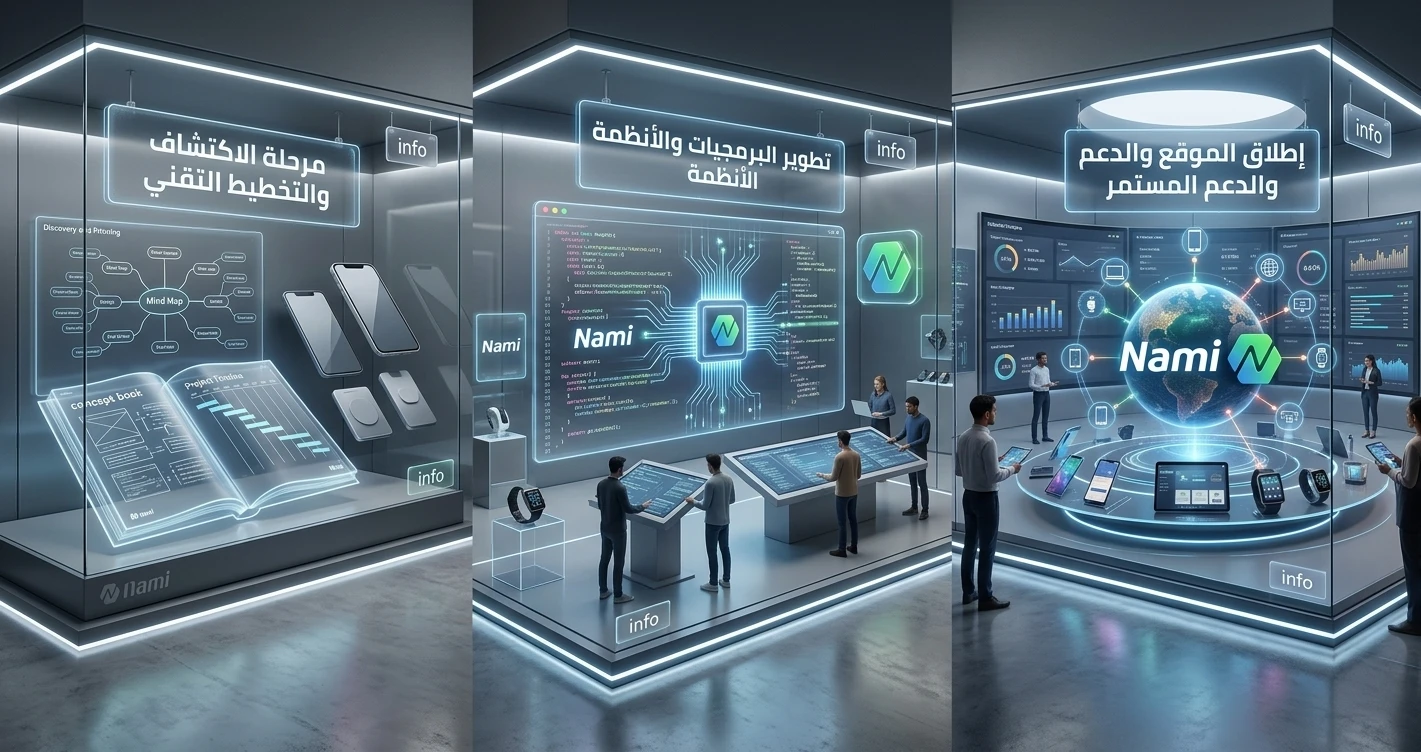
Website and App Development Stages: From Planning to Launch
Digital projects go through several stages to turn an idea into a usable product. Clear planning helps reduce unnecessary changes, improve communication between the client and development team, and define the deliverables for each stage.
1. Analyze the Idea and Define Project Requirements
Development begins by understanding the business, target audience, and goal of the website or app. This stage includes identifying required features, such as registration, search, booking, payment, and order management, depending on the project.
Priorities should also be set to distinguish essential features from those that can be added later. Documenting requirements provides a reference throughout development.
Nami Tec’s technical consulting services can help assess requirements and identify suitable solutions and technologies before development begins.
2. Plan Pages and Features
Once requirements are defined, the website or app structure is mapped out, including its pages, screens, and relationships. This planning clarifies the user journey and identifies the data and features needed in each part of the system.
For websites, this may include organizing the home page, service pages, product pages, and contact page. Mobile apps may require planning registration, profile, order, notification, and other service-related screens.
3. Design Interfaces and User Experience
At this stage, requirements are translated into a visual design that reflects the project’s identity and target audience. This includes arranging information, making buttons clear, simplifying navigation, and designing forms and screens to help users complete their tasks.
UI and UX design services can help create clear interfaces that reflect the project’s identity and support ease of use.
The differences between websites and apps should be considered. A website needs to work well across browsers and screen sizes, while an app requires interfaces suited to mobile use.
4. Programming and Development
The team implements the agreed design and features. This may include front-end development, back-end services, databases, dashboards, and external integrations.
The technologies used vary according to the project type, performance and security requirements, and expected usage. Code should also be organized and features documented to support future maintenance and development.
5. Test the Website or App
Before launch, core functions should be tested to confirm that forms, links, registration, purchasing, or booking processes work as intended, depending on the project. Interfaces should also be tested on target devices and browsers, and technical issues that could affect usability should be reviewed.
Testing includes reviewing user permissions, confirming that external integrations work correctly, and checking that agreed features operate as required.
6. Launch and Follow-Up
This stage includes preparing the production environment and final settings, then publishing the website or app according to project requirements. After launch, the system may need performance monitoring, issue resolution, improvements, or new features.
Launch, maintenance, and update responsibilities should be defined in the agreement so that the process for addressing post-delivery needs is clear.
Custom Website Development, E-commerce Stores, and Ready-Made Apps
Choosing between ready-made solutions and custom development depends on project needs, budget, and available time. No single option is suitable for every company; each has benefits and limitations that should be considered before making a decision.
Ready-Made Solutions
Ready-made solutions may suit projects that need a quick launch and common features, such as displaying information or selling products using standard functionality. However, customization, integration, and scalability options should be reviewed to ensure the solution meets current and future requirements.
It is also important to understand licensing or subscription costs, customization limits, and whether data can be transferred or the solution replaced if needed.
Custom Development
Custom development makes it possible to build features that match the company’s way of working, such as specialized booking systems, dashboards, or order-processing workflows. It may require more time and budget, but can be suitable when ready-made solutions do not meet the project’s needs.
These projects require clearly documented requirements, prioritization of core features, and an agreement on file ownership, source code, and maintenance arrangements.
Developing an Online Store or an App Connected to It
If the goal is to sell products online, the project should define how products, inventory, orders, payments, shipping, and customer service will be managed. An online store may be sufficient for some businesses, while another project may benefit from a mobile app if customer usage patterns justify it.
You can explore Daya Plus as an example of a website that presents products and information about them. For a similar solution, define the product and order management features the business needs instead of relying on visual design alone.
Reviewing requirements before development helps avoid paying for unnecessary features or choosing a solution that is difficult to expand later.
Android and iOS App Development and Responsive Websites
Mobile app development must account for differences between operating systems and devices, while websites need to work properly across different screen sizes and browsers.
Android Apps
Android apps target users of devices running the Android operating system. The Android versions and devices to be supported should be defined, and the app should be tested against the required compatibility range.
The display of content, ease of navigation, and response of core features on target devices should also be considered.
iOS Apps
iOS apps target users of Apple devices. They require consideration of system requirements and platform-specific user experience, as well as preparation for publishing and updates under applicable policies.
The required app features, integrations with device capabilities, and post-launch update process should be defined.
Cross-Platform Apps
Some projects can use cross-platform technologies to build apps for Android and iOS from a shared codebase. This may help organize development, but suitability depends on the app’s features, performance requirements, and integration with device capabilities.
The choice should be made after comparing project needs, budget, maintenance requirements, and the features the app must provide.
Websites That Work Across Phones and Other Devices
A website should be easy to use on phones, computers, and tablets, with readable text, clear buttons, and menus suited to each screen size. Important features, such as forms, search, and checkout, should be tested on target devices.
You can explore Across East Recruitment as an example of a website for recruitment services. Reviewing website examples can help assess how information and services are presented, while the design and features should still be selected according to each business’s needs.
The final choice between a website, an app, or both depends on required features, audience, budget, and future development plans—not technology alone.
Website and App Development Costs and Factors Affecting Price
The cost of website and app design and development varies according to project type, scope, and required features. A single price cannot be set for all websites and apps without understanding the project details.
Key factors that affect cost include:
-
Project type: A corporate website has different requirements from an online store, app, or administrative system.
-
Number of pages and screens: Content volume and required interfaces affect the time needed for design and development.
-
Level of customization: Features built specifically for a project may require additional time and effort.
-
External integrations: Such as payment gateways, maps, customer relationship management systems, and other services.
-
Feature complexity: Such as account management, permissions, orders, and reports.
-
Design and user experience: The scope depends on interface customization and testing requirements.
-
Security and performance: Projects with specialized technical requirements may need additional configuration and testing.
-
Maintenance and operation: Potential costs include hosting, licenses, updates, and technical support.
To receive a clear quote, prepare a list of required features and determine whether the project needs a website, an app, or both. Also specify integrations, the expected timeline, and post-launch services.
Quotes should be compared based on scope and deliverables, not only on the total price. One proposal may include services that another does not.
Timeline for Website Design and Mobile App Development
Project timelines vary according to size, complexity, clarity of requirements, and how quickly designs and content are approved. A simple corporate website differs from a full e-commerce store, just as an app with limited features differs from a platform with multiple accounts, permissions, and integrations.
Factors that affect development time include:
-
Clarity of requirements at the start of the project.
-
Number of pages, screens, and required features.
-
Level of design and development customization.
-
Need to connect external systems or services.
-
Availability of content and data needed for development.
-
Number of review and revision rounds.
-
Time required for testing and resolving issues before launch.
It is best to agree on clear development stages, defining the deliverables for each stage and the responsibilities of the client and development team. This helps track progress and identify reasons for any timeline changes.
Technologies Used in Website and App Development
Technologies should be selected according to project requirements, rather than simply because a particular technology is popular. The goal is to choose an architecture that can be maintained and developed and that fits the required features, budget, and operating plan.
Common technical components include:
-
Front end: The part users interact with on the website or within the system interface.
-
Back end: Responsible for processing data, implementing business logic, and managing orders and operations.
-
Databases: Used to store, organize, and retrieve information according to system permissions.
-
APIs: Connect the website or app to other services and systems.
-
Mobile app technologies: Vary depending on whether native or cross-platform development is chosen.
-
Hosting and cloud infrastructure: Run the system and provide resources based on expected usage.
Explore Nami Tec’s cloud services when choosing a hosting environment and technical infrastructure, taking expected usage, performance requirements, and scalability into account.
Maintainability, availability of technical expertise, and scalability should be considered before selecting the final technology. Hosting, performance, and backup requirements should also be defined to suit the project and expected data volume.
Website and App Testing and Quality Assurance Before Launch
Structured testing helps identify issues before a website or app reaches users. It is not enough for the interfaces to look correct; core functionality, data, permissions, and performance must also be tested within the project scope.
Key testing areas include:
-
Functional testing: Confirming that buttons, forms, registration, search, and orders work correctly.
-
Compatibility testing: Testing the website or app on target devices and browsers.
-
User experience testing: Ensuring that workflows are clear and tasks are easy to complete.
-
Integration testing: Checking connections to payment services or external systems, where applicable.
-
Security testing: Reviewing permissions, settings, and security aspects relevant to the project.
-
Performance testing: Reviewing responsiveness and system behavior under expected usage conditions.
-
Pre-launch review: Ensuring that important issues have been resolved and the production environment is ready.
Nami Tec makes sure to test the website or app and verify its readiness before launch, helping reduce errors and improve product quality. Follow-up and maintenance continue after launch to help maintain performance and provide a reliable user experience.
Website or App Ownership and Source Code Rights
Project ownership should be clarified before work begins, as it defines the rights of the client and the development company regarding files, data, accounts, and the components used.
The agreement should ideally clarify:
-
Ownership of designs and files created specifically for the project.
-
Source code rights and how it will be handed over, according to the contract.
-
Ownership of the domain, hosting, and publishing accounts.
-
Access permissions for databases and dashboards.
-
Licenses for external libraries, tools, or services.
-
Responsibilities for transferring the project or handing it over to another team if needed.
Actual rights vary according to the contract, licenses, and applicable laws. They should therefore be documented clearly rather than assuming that all files and accounts are automatically transferred upon delivery.
Website and App Maintenance and Technical Support After Launch
A digital project’s lifecycle does not end when it is published. A website or app may need technical updates, performance improvements, or fixes for issues that appear during use. A maintenance plan helps organize this work and define how issues will be handled.
Depending on the agreement, maintenance may include:
-
Fixing technical issues that appear after launch.
-
Updating system components and dependencies.
-
Reviewing performance and responsiveness.
-
Improving existing features.
-
Adding new features under a separate scope of work or updated agreement.
-
Reviewing security settings and permissions.
-
Providing technical support and a process for submitting issues.
After launch, you can also use Nami Tec’s digital marketing services to support reaching target audiences in line with business goals and the nature of the products or services offered.
It is important to distinguish between a technical warranty, routine maintenance, and additional development, and to define the contract’s duration, support type, response time, and potential costs.
With Nami Tec, we stay by your side after your website or app launches, providing maintenance and technical support to help keep it stable and develop it as your needs grow.
Common Mistakes When Hiring a Website and App Development Company
Some poorly planned decisions can increase costs, delay launch, or result in a product that does not meet business needs. These risks can be reduced by clarifying requirements and reviewing the scope of work before signing a contract.
Common mistakes to avoid include:
-
Choosing a company based only on price, without reviewing delivery quality and included services.
-
Failing to define required features, which can lead to mismatched expectations during development.
-
Adding unnecessary features that increase complexity without clear user benefits.
-
Skipping pre-launch testing, which may allow issues that affect customers to go unnoticed.
-
Failing to clarify ownership of files and accounts, which can make future management or transfer difficult.
-
Neglecting maintenance and failing to define responsibilities after delivery.
-
Choosing unsuitable technology without assessing performance, scalability, and integration needs.
-
Failing to document the agreement, including timeline, delivery, revisions, and support.
A clear agreement covering the project scope, deliverables, and each party’s responsibilities helps improve collaboration and reduce disputes during development and after delivery.
Why Do Clients Choose Nami Tec as a Leading Website and App Design & Development Company?
Nami Tec provides digital services that include website and mobile app development, user interface design, technical consulting, digital marketing, and other solutions that can be tailored to each project’s needs.
With more than 9 years of experience, Nami Tec offers services that can be adapted to different business needs, including:
-
Website development: Creating websites suited to the business and its required features.
-
Mobile app development: Building Android and iOS apps according to project requirements.
-
User interface design: Organizing interfaces to improve ease of use.
-
Technical consulting: Helping identify suitable solutions and plan the project.
-
Digital marketing: Supporting reach to target audiences in line with marketing goals.
-
Cloud solutions: Assessing infrastructure and hosting options when needed.
To explore examples of projects delivered by the company, visit the Nami Tec portfolio and discover a variety of digital solutions, including Ajel, which combines a mobile app and a website.
Reviewing previous projects helps you understand the types of digital solutions offered and choose an approach that fits your goals and business needs.
Start Your Digital Project with Nami Tec
Whether you are planning to build a corporate website, develop an online store, or launch a mobile app, defining project goals and user requirements from the outset helps you choose the right technical solution and allocate your budget to the most important features.
Start by defining the service you want to provide, your target audience, and the features users need. Then discuss design and development options, cost, timeline, and maintenance before implementation begins.
Contact the Nami Tec team to discuss your project idea and explore website and app design and development services that fit your needs and digital goals.
Share :